
Williamsburg Registered Sex Offenders
Williamsburg County uses the statewide SLED SORT system to manage and publish sex offender registration data. Residents can search the Williamsburg County SORT portal for a list of all registered sex offenders currently residing in the county. Each record includes a photo, current address, physical description, and details of the qualifying offense. The registry is free to use and open to the public at all hours. Registration compliance is managed locally by the Williamsburg County Sheriff's Office in coordination with the South Carolina Law Enforcement Division.
Williamsburg County Quick Facts
How to Access the Williamsburg County Sex Offender Registry
The Williamsburg County SORT portal gives direct access to registry records filtered for this county. SORT is the Sex Offender Registry Tool built and maintained by SLED. You can search by name, zip code, or street address. Every result returns the registrant's full name, current address, photo, physical details, any known aliases, and the offense behind the registration requirement.
The main statewide portal at scor.sled.sc.gov covers all 46 counties and is the better choice when you want to search across county lines. Both versions use the same database. The county-specific portal simply filters that data down to Williamsburg County registrants.
For cross-state searches, the National Sex Offender Public Website connects to every state registry in the country. If someone moved from another state into Williamsburg County, NSOPW can confirm whether they were registered elsewhere before arriving.
Note: Always contact the Williamsburg County Sheriff's Office if you believe a listed address is outdated or if you have concerns about a specific registrant's current location.
Registration Requirements Under South Carolina Law
South Carolina Code Section 23-3-430 lists which offenses require registration. The statute covers criminal sexual conduct in all degrees, lewd acts on a minor, sexual battery with a minor, exposure offenses involving children, and crimes involving child sexual abuse material. The list also captures certain attempted crimes and accessory offenses where the underlying conduct would have triggered registration.
Registration applies regardless of the offender's age at conviction. A minor adjudicated delinquent for a qualifying offense may still be required to register upon reaching adulthood. South Carolina does not offer blanket exemptions based on juvenile status.
Anyone who spends 30 or more continuous days in South Carolina qualifies as a resident under Section 23-3-430. This means a person living in Williamsburg County part of the year, even without formal state residency, must register if they hit the 30-day mark. The duty begins on the day that threshold is crossed.
Registration Timelines and Out-of-State Offenders
A person released from prison who is required to register must do so within one business day of their release. Someone sentenced to probation or a suspended sentence must register within one business day of sentencing. These are hard deadlines with no automatic extensions.
Out-of-state offenders who move to Williamsburg County must register with the local sheriff's office within 10 days of establishing residency. South Carolina maps the out-of-state conviction to the equivalent in-state offense for classification purposes. The obligation to register starts when the person arrives, not when they obtain a South Carolina driver's license or formally update their legal address.
An address change within Williamsburg County must be reported within three business days. Relocating to a different county requires registration with that county's sheriff's office within 10 days. Each of these windows is a separate compliance requirement with its own penalties for failure.
Tier Classifications and Verification Frequency
South Carolina's three-tier system assigns each registrant to a classification based on the nature of their offense. The tier determines how often they must verify their information with local law enforcement.
Tier I offenders verify annually. This tier covers lower-severity qualifying offenses. Tier II offenders report every six months. Tier III offenders are required to verify in person every 90 days for the rest of their lives, with no possibility of reduction. Tier III is reserved for the most serious offenses and the highest-risk classifications.
The Williamsburg County Sheriff's Office tracks all three tiers and schedules verification appointments for local registrants. Failing to appear for a scheduled verification is a criminal violation on its own. Penalties escalate with each subsequent failure.
Public Disclosure Requirements Under Section 23-3-490
State law at Section 23-3-490 defines the information that must be included in the public registry. Each Williamsburg County registrant's record shows their full legal name, any aliases or nicknames, date of birth, current address, height, weight, hair and eye color, a current photograph, descriptions of visible tattoos or identifying marks, and the offense that led to registration. The county of conviction and sentencing date are also displayed.
The disclosure requirements are comprehensive by design. The legislature wanted the public to have enough detail to confirm a person's identity, not just their name. A photo combined with a physical description and confirmed address gives residents the information they need to recognize a registrant in their community.
Access to this information is free and unrestricted. No login or account is needed to search the SORT portal. The South Carolina Freedom of Information Act at Section 30-4-10 governs broader public records access for information not covered by the registry.
Penalties for Failing to Register
Non-compliance with sex offender registration in South Carolina is a criminal offense. A first conviction for failing to register carries a sentence of up to 90 days in jail. A second offense brings a mandatory minimum of one year. A third or subsequent violation is a felony with a potential sentence of up to five years.
These penalties also apply when an offender gives a false address, moves without reporting the change, or fails to complete a scheduled verification. Each violation is charged as a new criminal count. Prior violations count as priors for sentencing purposes, so repeat offenders face escalating consequences quickly.
SLED monitors compliance statewide. If a Williamsburg County registrant stops responding to verification notices or cannot be located at their listed address, SLED can flag them as non-compliant and share that status publicly through the SORT portal.
Note: Registrants marked as non-compliant have not yet been located by law enforcement and may remain in the area.
Residency Restrictions Near Schools and Daycares
Section 23-3-535 of the South Carolina Code bars certain registrants from living within 1,000 feet of a school, licensed childcare center, or public park. This restriction applies only to offenders whose qualifying conviction involved a minor victim. It does not apply to every registrant in the county.
Williamsburg County has a mix of rural and small-town areas. Even in a largely rural county, schools and childcare facilities create restricted zones that affect where qualifying offenders can legally reside. The Williamsburg County Sheriff's Office and state probation officers enforce compliance with these restrictions during regular supervision checks.
Residents who suspect a qualifying registrant is living inside a restricted zone should report it to the Sheriff's Office. Officers can investigate and, if a violation is confirmed, seek removal and additional charges.
Williamsburg County SLED SORT Registry
The Williamsburg County SORT portal provides the official public-facing registry for all registrants currently living in the county.
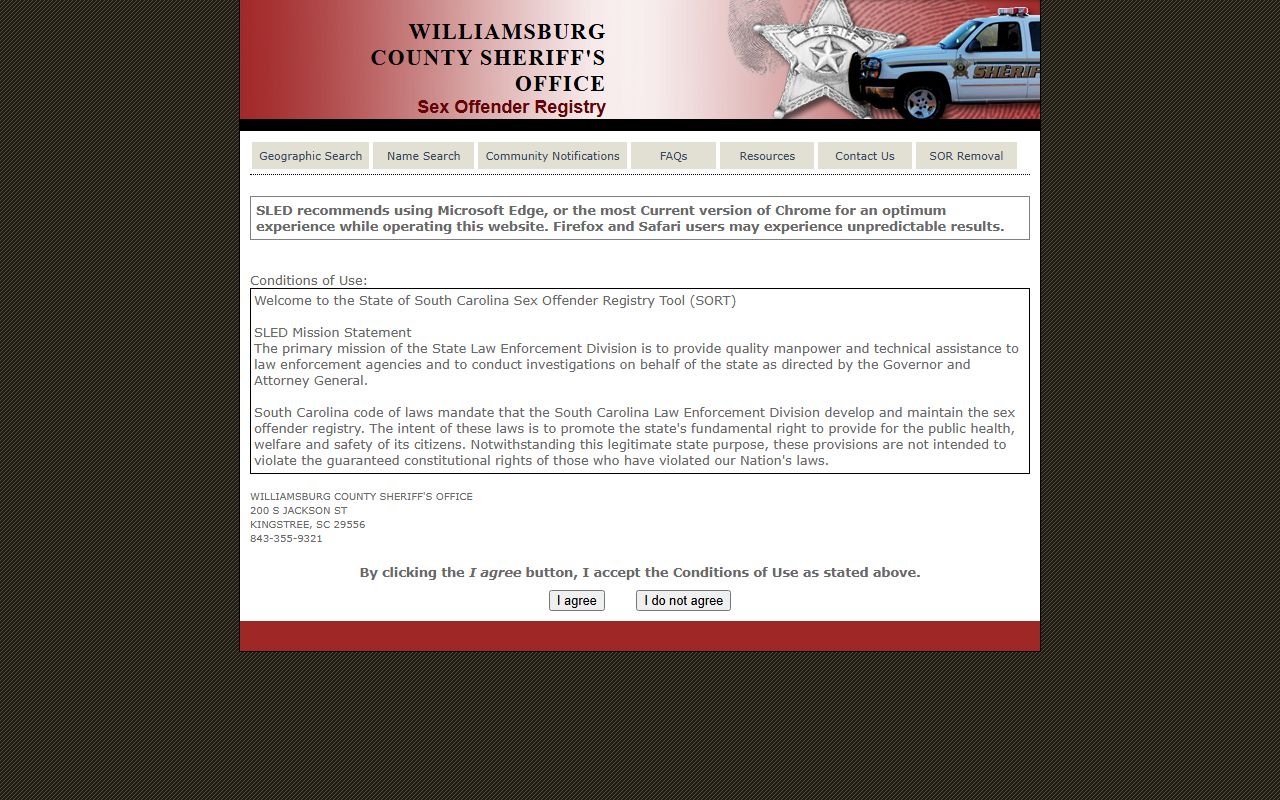
SLED updates the portal as registrants report changes and as officers confirm information during verification visits.
South Carolina SLED Statewide Registry
The South Carolina Law Enforcement Division hosts the statewide sex offender registry at sled.sc.gov, which powers both the county-specific and statewide SORT portals.
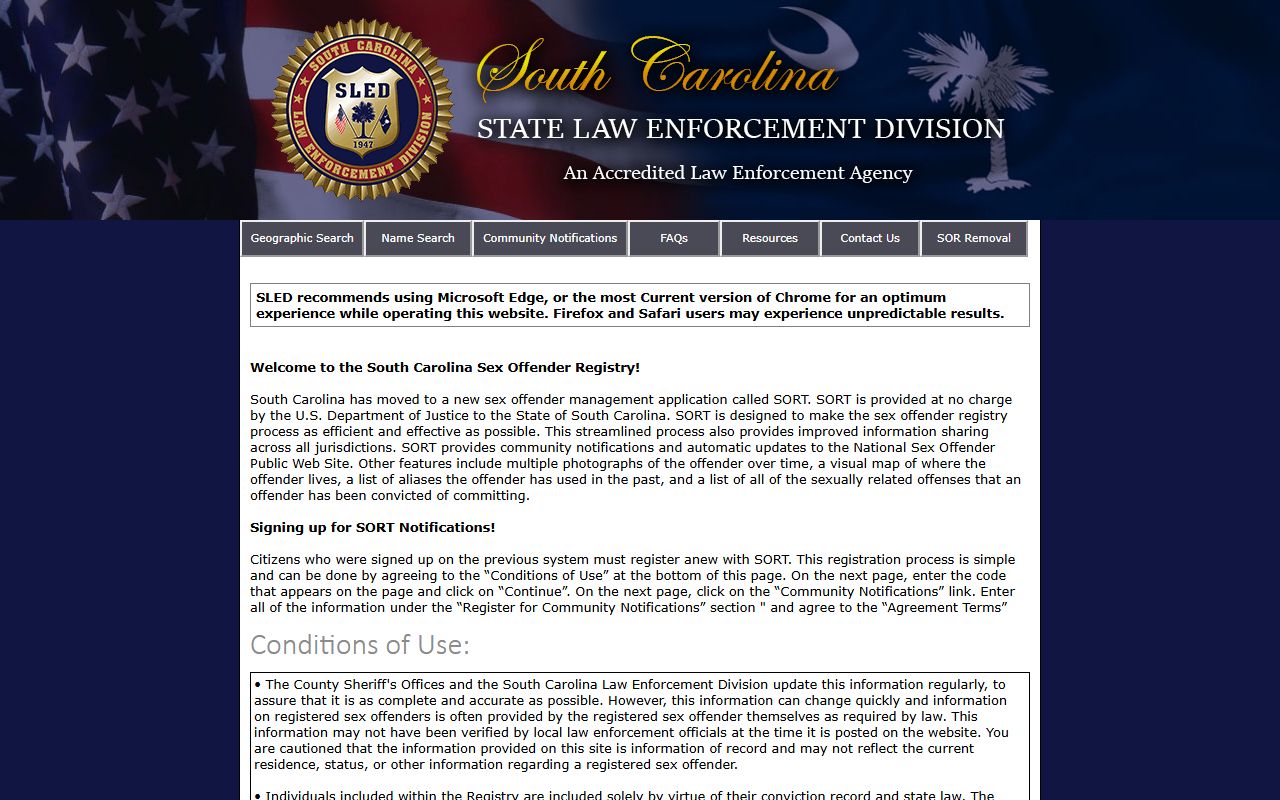
SLED coordinates compliance enforcement across all 46 counties and maintains the central database that local sheriff's offices use to track registrants.
SAVIN and Community Notification
South Carolina's SAVIN program, the Statewide Automated Victim Information and Notification system, is available to all Williamsburg County residents. SAVIN lets you sign up for automatic alerts when a specific offender's status changes. This includes release from custody, transfer between facilities, and changes to supervision status.
SAVIN is open to anyone, not just direct victims of a crime. A neighbor, a parent, or any concerned resident can enroll. The service is free and available statewide.
For legal guidance on the registry and related rights, the South Carolina Attorney General's office publishes resources and oversees the criminal division that handles sex offender compliance at the state level.
Cities in Williamsburg County
Kingstree is the county seat of Williamsburg County. The county is predominantly rural.
Nearby Counties
Williamsburg County is located in the coastal plain of South Carolina and borders several counties. Use the links below to check adjacent registries.