
South Carolina Sex Offender Registry Search
South Carolina maintains a public registry of sex offenders through the SLED SORT system, giving residents free access to search by name, city, county, zip code, or address radius. The registry covers all 46 counties and is updated regularly by SLED and county sheriffs. Whether you want to look up a specific person or check who lives near an address, the tools on this page connect you to accurate, up-to-date records on registered sex offenders across the state.
South Carolina Sex Offenders Quick Facts
How to Search South Carolina Sex Offenders Online
The South Carolina Law Enforcement Division runs the official registry through a platform called SORT, which stands for Sex Offender Registry Tool. SORT was provided at no charge by the U.S. Department of Justice and replaced the state's older system. Anyone who had an account on the previous platform must re-register with SORT to keep access to account features like email alerts. The public search itself requires no account and no fee.
You can reach the registry at scor.sled.sc.gov. The search form lets you look up sex offenders by first or last name, city, county, or zip code. You can also run a radius search of one to three miles around any street address in the state. Results include a map view that shows offender locations visually, which helps when you want a clear geographic picture of an area. The system also stores multiple photographs taken over time, so profiles may include more than one image of the same person.
The SLED SORT sex offender registry is the primary tool South Carolina residents use to search registered sex offenders statewide.
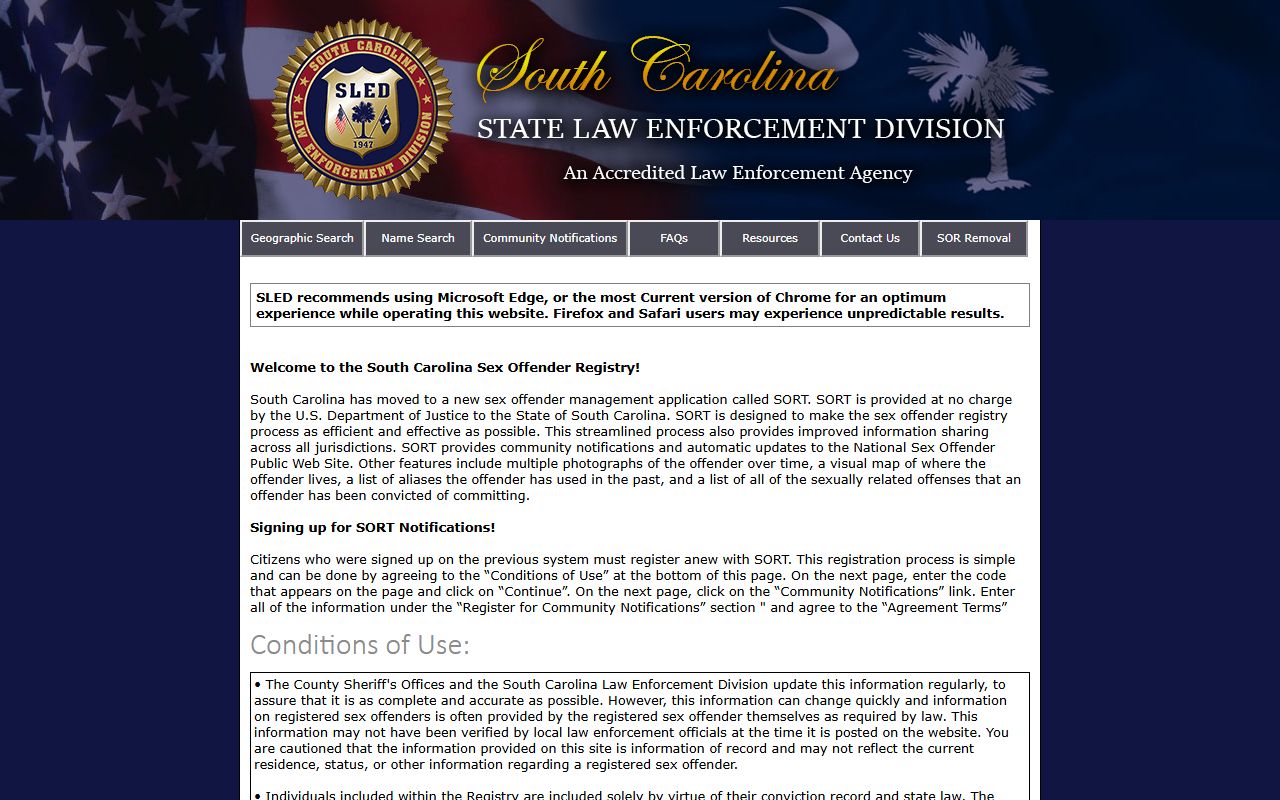
The SORT platform displays a map view along with detailed offender profiles, making it easy to see where registered sex offenders are located across South Carolina.
What the South Carolina Sex Offender Registry Contains
South Carolina law spells out exactly what the public can see in the registry. Under Section 23-3-490 of the South Carolina Code of Laws, each registry listing must include the offender's name, sex, race, age, date of birth, height, weight, and eye, hair, and skin color. The listing also shows the last reported address, any scars, marks, or tattoos, all aliases the person has used, the date of conviction, and the statute violated. A photograph is included when one is available.
One field that stands out is whether the person has been designated a sexually violent predator. This label appears clearly in the listing and carries its own set of rules for how often the person must check in with authorities. The registry also tracks the full offense history for each person, not just the most recent conviction. Alias tracking means that if someone has gone by a different name, that name is searchable and linked to the correct record. All of this data is updated on a regular basis by SLED and by the sheriff's office in each county.
The South Carolina Law Enforcement Division oversees all registry operations and works with county sheriffs to keep records current.
SLED coordinates with all 46 county sheriff offices to maintain accurate and timely registry data for registered sex offenders across South Carolina.
Note: The SORT system stores multiple photographs taken over time, so you may see more than one image in a single offender profile.
Who Must Register as a Sex Offender in South Carolina
South Carolina law requires any person convicted of a qualifying offense to register, regardless of age. This rule applies to anyone residing in the state. A person is considered a resident if they spend 30 or more total days in South Carolina over any 12-month period. That means someone does not need a permanent address to trigger the registration requirement. Staying in the state for extended stretches is enough to qualify.
The age provision is broad. Adults convicted of covered offenses must register. Children who are 14 or older and adjudicated delinquent for a Tier III offense are also required to register. The law does not carve out an automatic exemption for juvenile offenders at that tier level. Registration applies whether the conviction came from a South Carolina court or from another state, as long as the person now lives here.
People released from incarceration must register with the Sheriff's Office in their county of residence within one business day of release. Those sentenced to probation instead of prison must register within one business day of sentencing. If someone moves to a new county, they have 10 days to complete registration there. Address changes within the same county require notification to the sheriff within three business days. The same three-day window applies when someone leaves the state entirely.
SLED's sex offender registry page lists all applicable registration requirements and links to the relevant sections of state law.
South Carolina Sex Offender Tiers and Registration Schedules
South Carolina uses a three-tier system to classify sex offenders. Each tier carries its own registration schedule based on the severity of the underlying offense. Tier I covers offenses such as criminal sexual conduct in the third degree, assault with intent to commit criminal sexual conduct, and criminal sexual conduct with a minor in the third degree. Tier I offenders must register once a year.
Tier II covers more serious crimes, including criminal sexual conduct in the second degree and criminal sexual conduct with a minor in the second degree. People at this level must register every six months. Tier III is the highest classification and includes criminal sexual conduct in the first degree, criminal sexual conduct with a minor in the first degree, and kidnapping. Tier III sex offenders must register every 90 days and must continue doing so for life. There is no path to reduced registration frequency for someone at this tier.
The tier level shapes how the state views the risk a given person poses to the public. Higher tiers mean more frequent in-person check-ins at the sheriff's office, stricter monitoring, and greater scrutiny. Sexually violent predators who are eventually released after commitment to the Department of Mental Health fall under the same lifetime, every-90-days requirement that applies to Tier III sex offenders.
The South Carolina Attorney General's Office provides information on sexually violent predator status and registry obligations under state law.
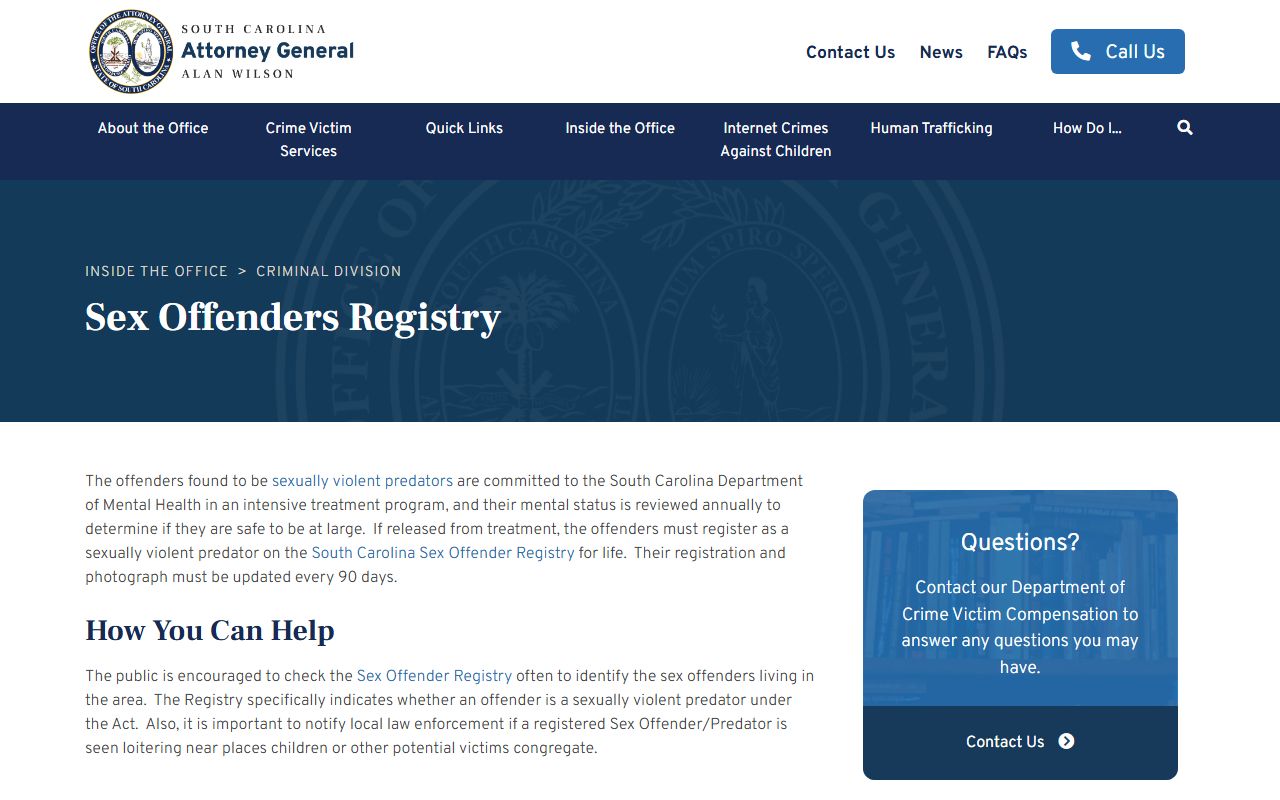
The Attorney General's Office encourages South Carolina residents to check the registry often and to notify local law enforcement if a registered sex offender is seen near places where children gather.
Sexually Violent Predators and South Carolina Law
South Carolina law sets aside a distinct category for sexually violent predators. These individuals are committed to the Department of Mental Health for intensive treatment rather than released directly into the community after serving a prison sentence. Their status is reviewed by the state on an annual basis. If the state determines that a sexually violent predator is ready for release, that person must still register as a sex offender for life and must check in every 90 days without exception.
The registry clearly marks each listing that carries the sexually violent predator designation. This makes it easy for the public to identify which offenders hold this status when searching records in SORT. The Attorney General's office maintains a dedicated phone line for sexually violent predator matters at 1-803-734-3243. Victim advocates can also reach the AG's office at 1-800-213-5652.
Residents are encouraged to contact local law enforcement any time a registered sex offender or sexually violent predator is seen near schools, parks, playgrounds, or other places where children or vulnerable people tend to gather. This kind of community awareness is one of the main reasons South Carolina makes registry data publicly available.
Note: The sexually violent predator designation appears directly in each offender's SORT profile, so you can confirm this status without contacting any agency.
South Carolina Sex Offenders and Residency Restrictions
South Carolina places strict limits on where certain sex offenders can live. Offenders convicted of hands-on offenses against minors are barred from residing within 1,000 feet of a school, daycare center, children's recreational facility, park, or playground. This restriction is measured from property line to property line. It applies regardless of when the person registered or where they lived before the law took effect.
Local governments in South Carolina may add their own distance requirements on top of what state law demands. Some jurisdictions have enacted rules that go beyond the 1,000-foot baseline. Violating a residency restriction can lead to criminal charges that are entirely separate from any failure-to-register violation. Both can be prosecuted at the same time if the facts support it.
Title 23, Chapter 3 of the South Carolina Code of Laws covers registration requirements, tier classifications, and residency restrictions in full detail.
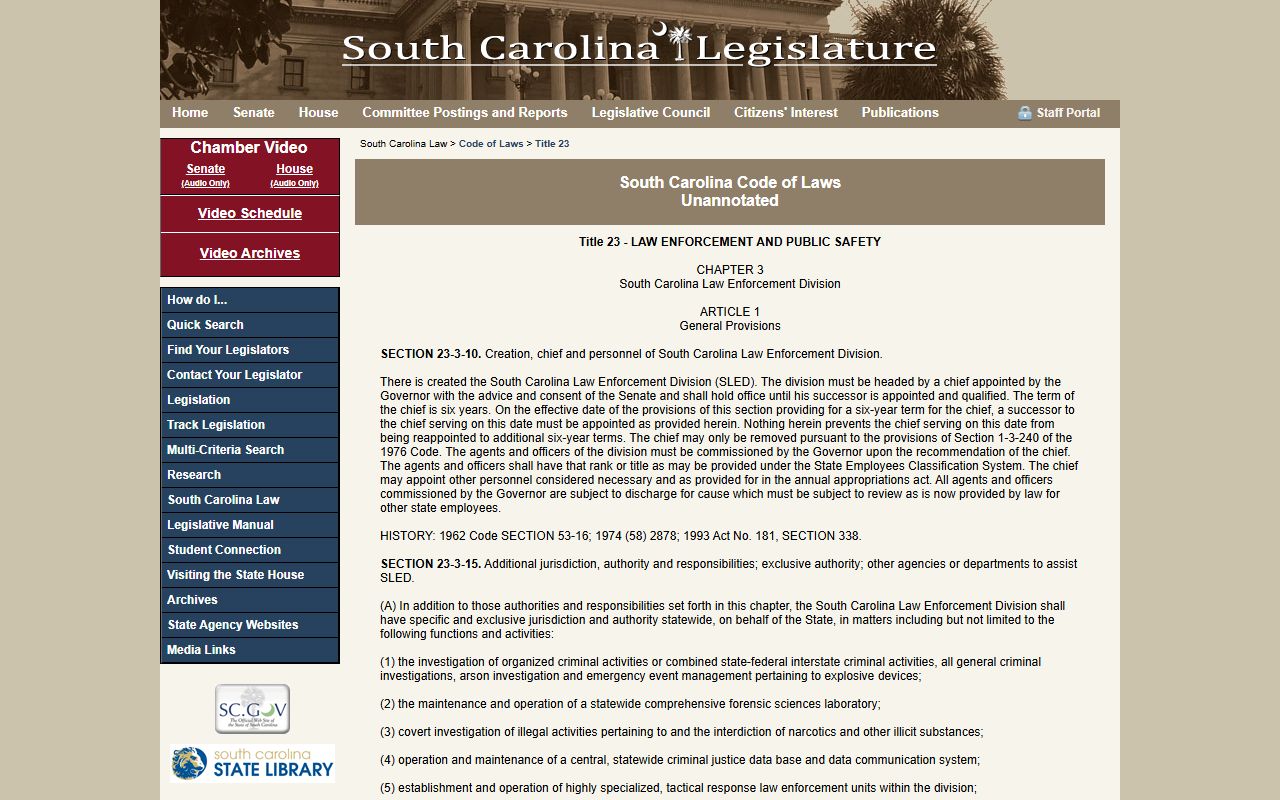
The South Carolina Code lays out the full legal framework governing who must register as a sex offender, how often they must check in, and where they are permitted to live.
Penalties for Failing to Register in South Carolina
South Carolina treats failure to register as a serious criminal matter. A first offense is a misdemeanor that carries a mandatory minimum of 90 days in jail. A second offense is also a misdemeanor but requires a full year of mandatory incarceration. A third or subsequent offense is charged as a felony and carries a mandatory minimum of five years in prison. These are minimum sentences, not caps. A judge may impose more time depending on the circumstances.
The law also addresses misuse of registry data. Using registry information to unlawfully injure, harass, or commit a crime against any person listed in the registry is a separate offense. Misuse can add up to $1,000 and six months to a misdemeanor sentence or up to five years to a felony sentence. The registry exists as a public safety tool. Using it to harm or intimidate someone defeats its purpose and carries real legal consequences.
Note: SLED's own conditions of use state clearly that the registry is meant to make information accessible, not to target any specific individual for harm or harassment.
Community Notifications and Email Alerts
SORT includes a built-in alert system that lets you sign up for email notifications about sex offenders in a specific area. When a registered sex offender moves into or out of a neighborhood you are monitoring, the system sends an automatic update. This was one of the key improvements South Carolina gained when switching from its older registry to SORT. The new platform handles these notifications more reliably and with broader geographic coverage.
Community notifications also flow automatically from SORT to the National Sex Offender Public Website run by the U.S. Department of Justice. This means that when an offender registered in South Carolina moves to another state, that state's system receives notice. The reverse is also true. If someone from another state registers in South Carolina, SORT captures the record and displays it in local search results. The national system allows multi-state searches by name, zip code, or address radius, which is useful when tracking someone who has moved.
The South Carolina Attorney General's office urges the public to check the registry on a regular basis. Staying current on who lives in a given area is one of the simplest ways to use this resource. The AG's general line is 1-803-734-3970, and constituent services can be reached at 1-803-737-3953 for help with specific questions.
Inmate Records and Victim Notification in South Carolina
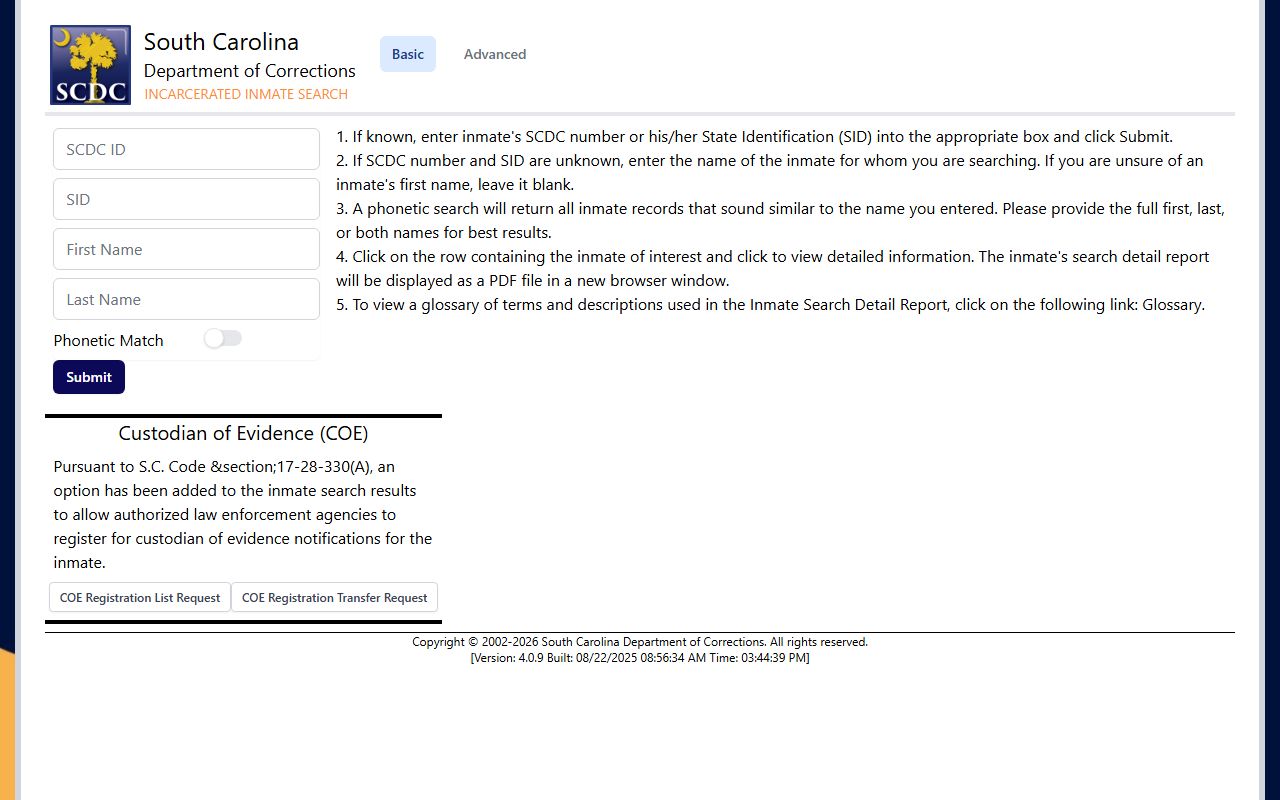
The South Carolina Department of Corrections maintains a separate public search tool for inmate records. You can access it at public.doc.state.sc.us. Searches can be run by SCDC number, State ID, or name. The system uses phonetic matching, so slight spelling differences do not block results. Each record shows the offense, sentence length, admission date, and projected release date. The DOC is located at 4444 Broad River Road in Columbia and can be reached by phone at (803) 896-8500.
Before a sex offender is released from the Department of Corrections, SLED is required by law to notify the sheriff in the county where the offender plans to reside. This happens automatically. It gives local law enforcement time to prepare before the person arrives in the community. Once released, the offender must register with that county's sheriff within one business day.
The South Carolina DOC inmate search lets you look up current and recently released inmates by name, SCDC number, or State ID.
Public access to inmate records and sex offender data in South Carolina is supported by the state's open records law, which presumes that government records are open unless a specific exemption applies.
For victim notification, the SAVIN program (Statewide Automated Victim Information and Notification) tracks custody status changes and alerts victims when an offender's status shifts. VINE, the national version of the same system, extends coverage across state lines. SLED's Victim/Witness line is 1-803-896-7654. A national hotline for missing and exploited children is available at 1-800-32-CHILD.
South Carolina Public Records and FOIA Access
The sex offender registry is one tool among many. South Carolina's Freedom of Information Act, found at Title 30, Chapter 4 of the state code, presumes that public records are open unless a specific exemption applies. Standard copy fees are 25 cents per page. Some counties charge around $15 per hour for search and retrieval time. Certified copies typically cost $5 per document.
Court records, arrest reports, and other criminal history documents can often be obtained through this process. The registry itself is free and fully online, but if you need supporting documentation beyond what appears in a SORT profile, a public records request to the relevant agency is the standard approach. SLED's main office is at 4400 Broad River Road, Columbia, SC 29210. The main phone number is (803) 896-2601. Registry-specific questions can be sent by email to sor@sled.sc.gov.
Browse South Carolina Sex Offenders by County
Select a county below to find sex offender registry information for that area.
Browse South Carolina Sex Offenders by City
Select a city below to find sex offender registry information for that location.