
Union County Sex Offender Registry
Union County, South Carolina uses the statewide SLED SORT system for sex offender registration and public access. Residents can search the registry at the Union County SORT portal, which is maintained by the South Carolina Law Enforcement Division. The portal lists all registered sex offenders in Union County with current addresses, photos, physical descriptions, and offense details. Access is free and does not require an account. Registration and compliance oversight is handled by the Union County Sheriff's Office in coordination with SLED and state probation authorities.
Union County Quick Facts
How to Search Union County Sex Offenders
The Union County SORT portal is the easiest way to look up registered sex offenders within the county. SORT stands for Sex Offender Registry Tool. The search function allows you to look by name, zip code, or street address. Each match returns a profile with the registrant's full name, current address, photo, physical description, known aliases, and the offense that triggered the registration requirement.
For a broader search that includes all of South Carolina, use the main portal at scor.sled.sc.gov. That version includes all 46 counties. It is particularly useful when checking someone who may have recently arrived in Union County from another part of the state.
The National Sex Offender Public Website covers all 50 states and Washington D.C. Use it when you are not sure whether someone is registered in South Carolina or another state entirely. All three tools draw from official government databases.
Note: Search results reflect the most recently verified address. Contact the Union County Sheriff's Office if you believe a listed address is no longer accurate.
Who Must Register as a Sex Offender in Union County
South Carolina Code Section 23-3-430 defines who must register. The requirement covers anyone convicted of a qualifying sexual offense in South Carolina or in any other state. Qualifying crimes include criminal sexual conduct in all three degrees, lewd acts on a minor, sexual battery of a minor, and offenses involving child sexual abuse material. The full list is broad and covers both completed offenses and certain attempts.
Age at the time of conviction does not exempt someone from registering. A person convicted as a minor of a qualifying offense may still be required to register as an adult. The law is clear on this point, and there are no automatic exceptions based on the offender's age at sentencing.
Any person who spends 30 or more days in South Carolina is considered a resident under state law. This means someone who primarily lives elsewhere but spends significant time in Union County must register locally. The 30-day rule applies even without a formal change of legal address.
Registration Timelines and Requirements
People released from prison must register within one business day of their release. Those given probation or a suspended sentence must register within one business day of sentencing. These windows are short and strictly enforced. There is no grace period beyond the statutory deadline.
Out-of-state offenders who move to Union County must register with the Union County Sheriff's Office within 10 days of establishing local residency. South Carolina treats their out-of-state conviction the same as it would an equivalent in-state offense. The duty to register arises on the day they arrive, not when they obtain a South Carolina ID or formally notify another state of their move.
When an offender changes their address within Union County, they must report that change within three business days. Moving to a different county in South Carolina requires registration with the new county's sheriff's office within 10 days. Failing to meet any of these deadlines can lead to arrest and prosecution.
Three-Tier System and Verification Schedules
South Carolina uses a three-tier classification system tied to offense severity. The tier determines how often a registrant must verify their information with local law enforcement.
Tier I covers the lowest-risk offenses. Those registrants verify once per year. Tier II covers moderate-risk offenses and requires verification every six months. Tier III is reserved for the highest-risk offenses and mandates verification every 90 days with no end date. Tier III registrants must appear in person every three months for the rest of their lives.
The Union County Sheriff's Office schedules and tracks all three tiers for registrants in the county. Missing a scheduled check-in is a criminal offense on its own, separate from any underlying registration violation. The penalties scale with each subsequent violation.
Penalties for Non-Compliance
A first conviction for failing to register as a sex offender in South Carolina carries up to 90 days in jail. A second offense brings a mandatory minimum of one year in prison. A third or subsequent violation is charged as a felony and carries up to five years in prison.
These penalties apply to any form of non-compliance, including providing a false address, missing a scheduled verification, and failing to report an address change within the required window. Courts treat each violation as a new criminal charge. Prior offenses are counted as priors, so the escalation from misdemeanor to felony can happen relatively quickly for repeat violators.
SLED tracks compliance at the state level and can issue alerts when a registrant goes missing from a county registry. Local officers follow up on those alerts as part of their enforcement duties.
Note: An offender listed as non-compliant in the SORT portal has failed to meet a registration requirement and may still be in or near the county.
What Information Is Available to the Public
Section 23-3-490 of the South Carolina Code sets out what the public registry must disclose. For each Union County registrant, the record includes full legal name, aliases, date of birth, current address, height, weight, hair and eye color, current photo, any distinguishing tattoos or marks, and the specific offense that required registration. The county where the conviction occurred and the sentencing date are also listed.
This information is intended to be actionable. A photo combined with a physical description and current address gives residents enough to make a confident identification. The registry is designed for community use, not just law enforcement use. Any person can access it at any time without cost or registration.
Additional public records about Union County residents may be available under the South Carolina Freedom of Information Act at Section 30-4-10. FOIA requests can be submitted to the appropriate county or state agency.
Residency Restrictions and School Zones
South Carolina Code Section 23-3-535 prohibits certain registered sex offenders from living within 1,000 feet of a school, licensed daycare center, or public park. This restriction applies when the registrant's qualifying offense involved a minor victim. Not all registrants are subject to this rule, but those who are cannot legally reside within a restricted zone.
Union County is a smaller county by population. Even so, the restriction matters in the city of Union and near any school or licensed childcare facility in the area. Probation officers and the Sheriff's Office monitor compliance with these geographic limits as part of regular supervision.
If a registrant is found to be living within a restricted zone, removal can be ordered and additional charges may follow. Community members who believe a registrant is in violation can report it to the Union County Sheriff's Office.
Union County SLED SORT Registry
The Union County SORT portal is part of the statewide SLED sex offender registry system and provides direct public access to registrant data for this county.
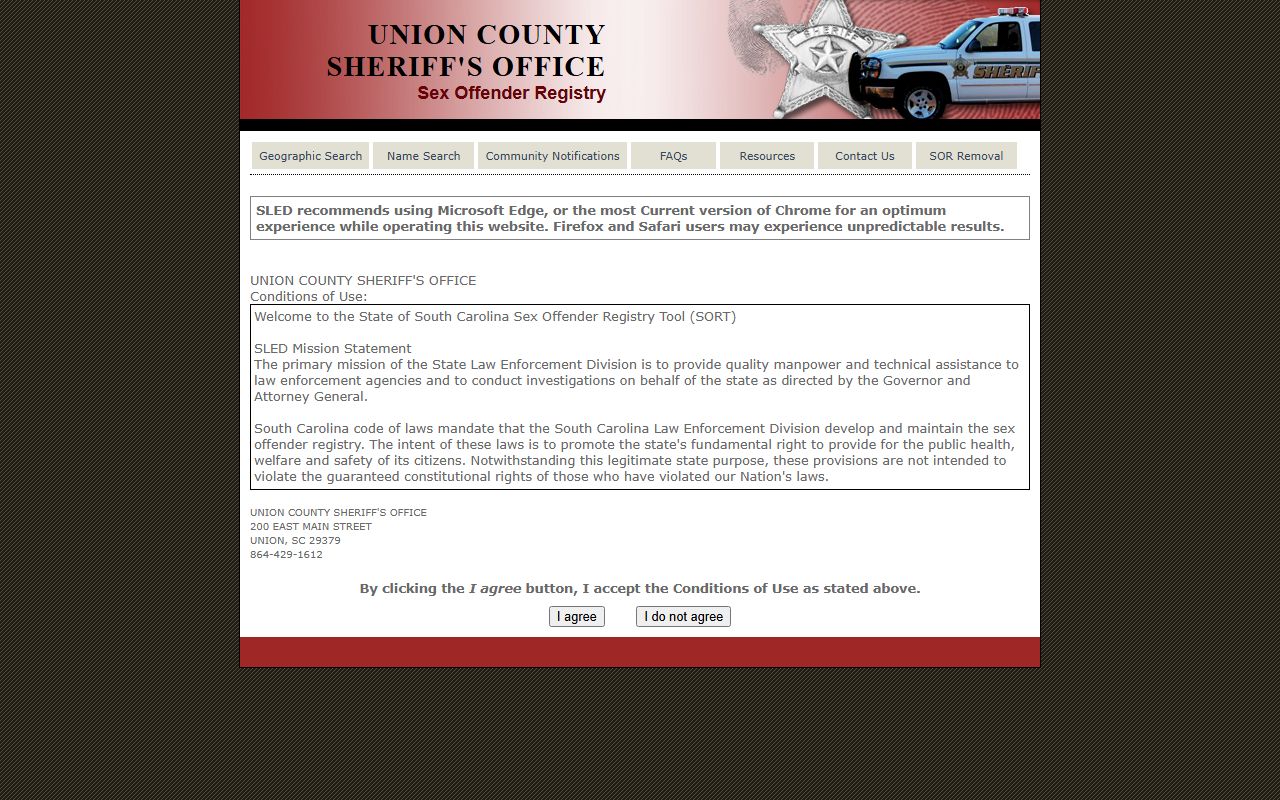
The portal is free, open around the clock, and requires no account to use.
Attorney General Resources on Sex Offender Registration
The South Carolina Attorney General's criminal division provides guidance and oversight for the state's sex offender registry system and supports local law enforcement with complex cases.
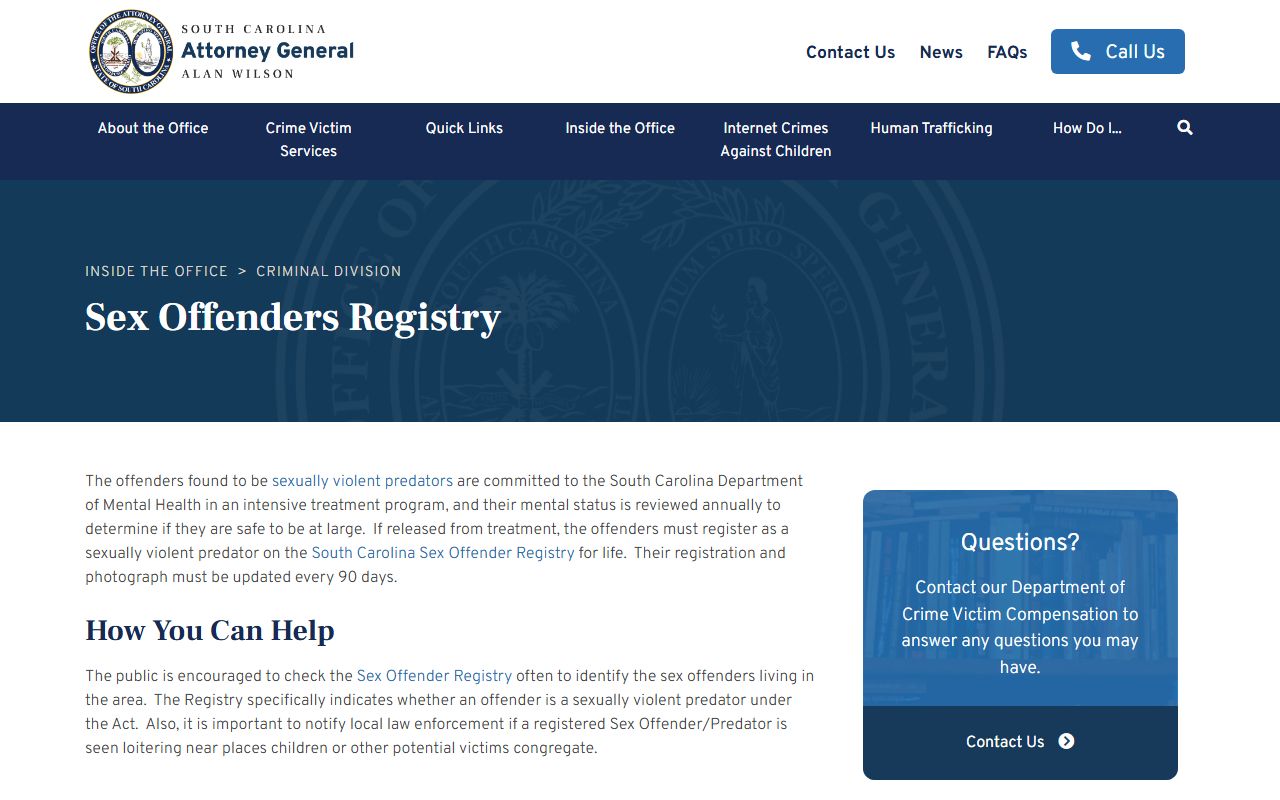
The AG's office can be contacted for legal questions about how the registry system operates or when cases require state-level prosecution support.
SAVIN and Victim Notification
South Carolina's SAVIN system, the Statewide Automated Victim Information and Notification program, allows residents to sign up for automated alerts tied to a specific offender. When that person is released, transferred, or experiences a status change, SAVIN sends a notification. This service is available statewide and is not limited to crime victims. Anyone can enroll to track a specific registrant.
SAVIN complements the SORT registry by providing real-time updates rather than requiring residents to check the portal manually. It is especially useful for people who live near a registrant and want immediate notice of any changes to their status.
Cities in Union County
Union is the county seat of Union County. The county is largely rural with scattered small communities throughout.
Nearby Counties
Union County is located in the Upstate region of South Carolina and shares borders with several neighboring counties. Check the registries below if you live near a county line.